

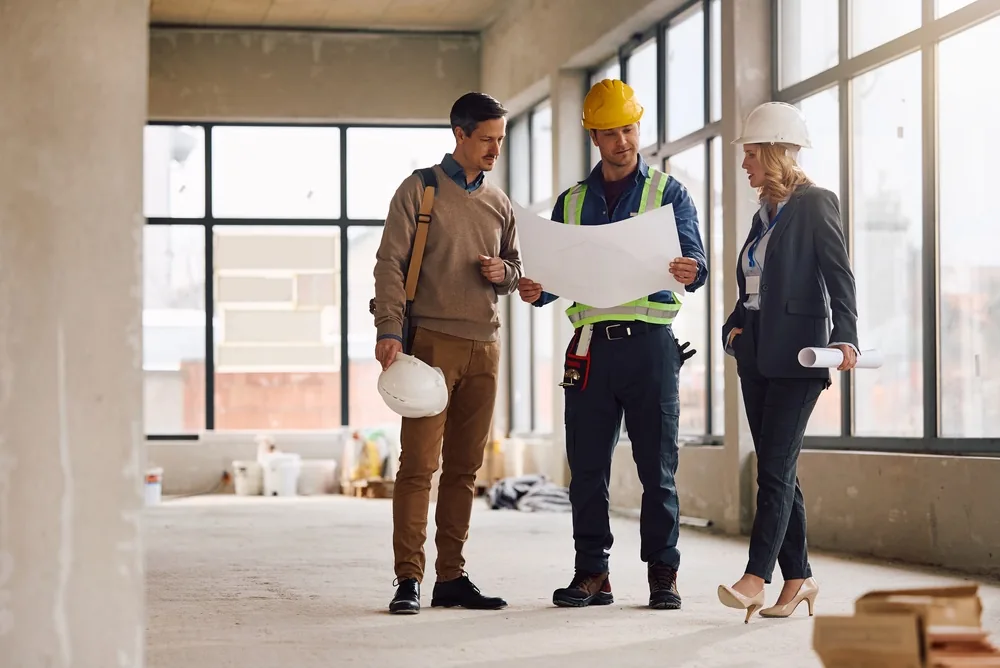
A single New York City construction site can have a general contractor, half a dozen subcontractors, a safety company, and a property owner all working within feet of each other on any given day. When an accident happens in that environment, figuring out who caused it is rarely as simple as identifying the one crew on the worksite.
Injured workers often assume their claim is limited to their direct employer. In reality, New York law holds certain owners, general contractors, and subcontractors responsible for job site safety.
General Contractors, Subcontractors, and Owners: Who Is Responsible for What
Large-scale projects in New York City rarely involve a single employer. A high-rise residential tower in Manhattan, a commercial redevelopment in Brooklyn, or a public infrastructure project spanning several city blocks all require coordination between many companies working at once, often in overlapping physical space. Each party has its own crew, equipment, and safety obligations.
General Contractors
The general contractor typically oversees the overall project, coordinates subcontractors, and maintains safe conditions across the site. Because of this oversight role, general contractors are named in construction accident claims even when they didn’t directly cause the accident.
Subcontractors
Subcontractors are hired to perform specialized work, such as electrical, plumbing, steel, or masonry. They’re responsible for the safety of their own crews and equipment, and for following the safety procedures required for their specific trade. When a subcontractor’s work or equipment contributes to an accident, that company can be held responsible for the resulting injuries.
Property Owners
Property owners and developers commissioning the work also carry safety obligations under New York law, particularly when it comes to ensuring that contractors follow required safety practices under New York Labor Law.

When More Than One Company Can Be Held Liable
These roles don’t operate in isolation. New York law recognizes that certain safety duties can’t be passed off from one party to another. When a general contractor or property owner is legally responsible for providing safety equipment or maintaining safe conditions, that responsibility doesn’t disappear just because the equipment came from a subcontractor or the failure occurred on a portion of the site controlled by someone else. This is often described as a non-delegable duty, and it’s a central reason multiple companies can face liability from a single accident.
Because responsibility is often shared rather than isolated, identifying every company connected to an accident usually requires a close look at the contracts, safety assignments, and daily operations on the site, not just the immediate cause of the injury.
New York Labor Law Protections on Multi-Contractor Sites
New York law gives injured construction workers several paths to hold a company accountable. When a project involves multiple contractors, these laws often apply to more than one at once.
Falls and Falling Objects
Labor Law 240(1), often called the Scaffold Law, applies to falls from heights and falling objects. What makes this law different from the others is that it can create absolute liability.
The law requires building owners and contractors to provide proper protective equipment for elevation-related work, such as scaffolding, netting, harnesses, and other fall protection devices. When that equipment is missing, inadequate, or fails and causes an injury, those parties can be held responsible for the accident.
A worker’s mistake doesn’t change that outcome, and neither does an argument that someone else was at fault. This is a much stronger form of liability than ordinary negligence, and it’s part of why the Scaffold Law is such an important tool for injured workers.
Violations of Specific Safety Regulations
Labor Law 241(6) requires construction, demolition, and excavation sites to follow detailed safety standards set out in New York’s Industrial Code. These standards cover day-to-day job-site conditions, including how debris and materials are removed, how excavations and open pits are protected, how walkways and floors are kept clear of tripping hazards, how areas below overhead work are protected from falling materials, and how equipment and work areas are lit.
To bring a claim under this law, you must show that a specific safety standard was violated and that the violation contributed to the accident.
A General Duty to Keep the Site Safe
Labor Law 200 is closer to a traditional negligence standard than the other two laws. It requires owners and contractors to keep a construction site reasonably safe for the workers. This law often comes into play in situations such as slipping hazards, poor lighting in a work area, unsafe storage of materials, cluttered walkways, or a hazardous condition created by one company’s work that puts another company’s workers at risk.
A claim under this law generally requires showing that the responsible party caused or created the condition, or had notice of the dangerous condition, either because they knew about it directly or because it existed long enough that they should have discovered it, and failed to correct it.
On a site with several parties, liability can also depend on which company controlled the specific area or task connected to the hazard, since responsibility under this law often follows whoever directed the work rather than just automatically falling on the owner or general contractor.
Can I File a Claim Against More Than One Company After a Construction Accident?
Yes. When a construction-site accident involves more than one company’s work, equipment, or safety failures, an injured worker isn’t limited to pursuing a claim against a single party.
These claims don’t have to be brought one at a time or in sequence. A worker can pursue multiple parties in the same case, and each company’s responsibility is evaluated separately based on what that company failed to do.
Pursuing claims against multiple companies doesn’t mean dividing compensation into smaller pieces. In cases involving serious or permanent injuries, a worker’s total losses can exceed what a single company or policy can cover.
What if the General Contractor Says a Subcontractor Was at Fault?
After an accident, a general contractor may point to a subcontractor, and a subcontractor’s actions or equipment can certainly contribute to an injury. But that doesn’t mean the general contractor is off the hook.
The non-delegable duty applies directly here: a general contractor’s responsibility for site safety, or a property owner’s responsibility for required protections, doesn’t transfer just because a subcontractor was performing the work.
In practice, this often means an accident traced back to a subcontractor’s failure can still lead to a claim against the general contractor, the property owner, or both, in addition to any claim connected to the subcontractor itself. Sorting out how much each party contributed is usually part of investigating the accident, not a reason to rule out a company from the outset.
Evidence That Helps Identify Responsible Parties
On a job site with this many moving parts, the truth about who was responsible rarely sits on the surface. It’s buried in paperwork, buried in who signed off on what, and buried in conversations between companies that a worker on the ground was never part of. Getting to that truth takes more than knowing an accident happened; it takes reconstructing exactly how the site was being run at the time.
Some of the most telling evidence includes:
- Contracts and subcontractor agreements showing which company controlled a specific task or area
- Daily logs, safety reports, and inspection records
- Photographs or video capturing the scene and the conditions that led to the accident
- Statements from coworkers, supervisors, or other trades working nearby
- Incident reports filed in the aftermath
Most of this evidence lives in filing cabinets and shared drives that belong to the companies involved, not to the worker who got hurt. That’s where a construction accident attorney becomes essential: requesting records companies would rather not hand over, tracing a chain of responsibility back to every party that had a hand in it, and pushing toward the full range of damages an injury like this can carry, from medical bills and lost income to the pain and disruption that don’t show up on a pay stub.

Talk to an NYC Construction Accident Lawyer About Your Case
Being injured on a construction site is stressful enough without also having to untangle who was responsible. Workers often assume the answer is simple, only to learn later that the accident involved decisions and failures by more than one company on the site.
At Oresky & Associates, PLLC, we’ve spent more than 30 years helping injured construction workers throughout New York get answers and hold the right parties accountable. If you were hurt on a construction site and aren’t sure who’s responsible, call us at (929) 209-4492 for a free consultation. Let us help you learn who is responsible and what you are entitled to in compensation for your accident.